“European Green Deal – Just Transition in Education” is a EU funded Jean Monnet project developed by Georgian National University SEU. The European Green Deal, as a strategy for the continent’s low-carbon economic development, has a direct impact on the European Union’s neighborhood. Accordingly, the goal of the project is to share the European experience related to green policy with the Georgian students and other interested parties.
While the application of the European Union’s (EU) energy and climate law and policy is no longer considered as a new phenomenon, the regional and domestic impacts of the newly negotiated European Green Deal (EGD) followed by the recently adopted European Climate Law and respective Fit-for-55 Package remain substantially under presented in theory and practice. Teaching and researching EGD related matters outside the formal boundaries of the EU is particularly limited due to its novelty and developing nature.
Contributing to closing this gap, the Jean Monnet Module project – “European Green Deal – Just Transition in Education” aims at sharing European perspective on the EU’s role as a ‘regulatory superpower’ that urges third countries to intensify their efforts alongside the EU in the aftermath of the so-called climate-neutrality ambition.
In doing so, Georgia being a country demonstrating its European aspirations, is used as a case study to measure how the new European Green Deal perspectives work within a certain geographical setting and what are the key pillars of integrating just transition mechanisms in education.
Georgia is one of the stakeholders, which over the last couple of years has witnessed an increasing interest in energy and climate law among legal subjects.
The country is characterized as an ‘EU-willing’ state endeavouring to create a stable, EU style market-oriented regulatory framework with competitive price setting mechanisms.
Beyond the ongoing energy sector reform via transposing EU energy legislation onto national legal system, Georgia is in the position to systemize its ill-regulated energy sector deeply intertwined with strong climate stressors.
In April 2021, Georgian Government has approved the updated targets of Nationally Determined Contribution (NDC) to curb carbon emissions after the breakthrough Paris Agreement submitted to UNFCCC Secretariat as well as the Climate Strategy 2030 and the Strategy Action Plan 2021- 2031.
On 11 December 2019, shortly before the global flue pandemic outbreak, the EU Commission has proposed the European Green Deal by issuing a Communication setting out the Green Deal vision as a new growth strategy transforming the EU into a fair and prosperous society, with a resource-efficient and competitive economy where there are no net emissions of greenhouse gases by 2050 (so-called ‘climate neutrality commitment’).
As a backbone of the proposed decarbonization strategy, in June 2021, the EU has finalized formal procedures of adopting the European Climate Law enshrining the goal to reach net zero emissions into law, plus hosting a set of measures to achieve it.
Learn more about our
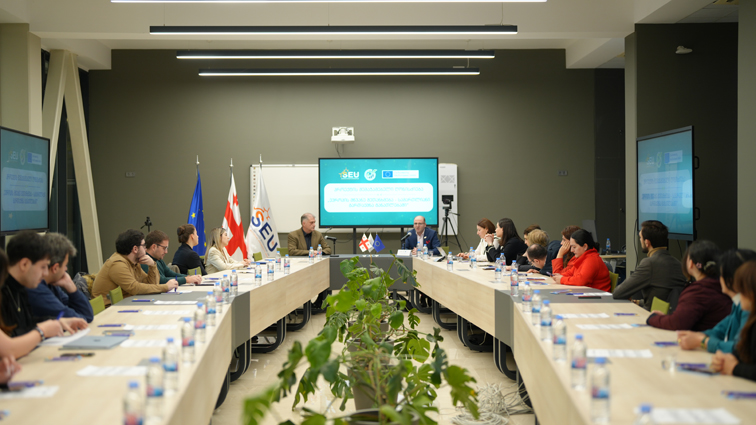
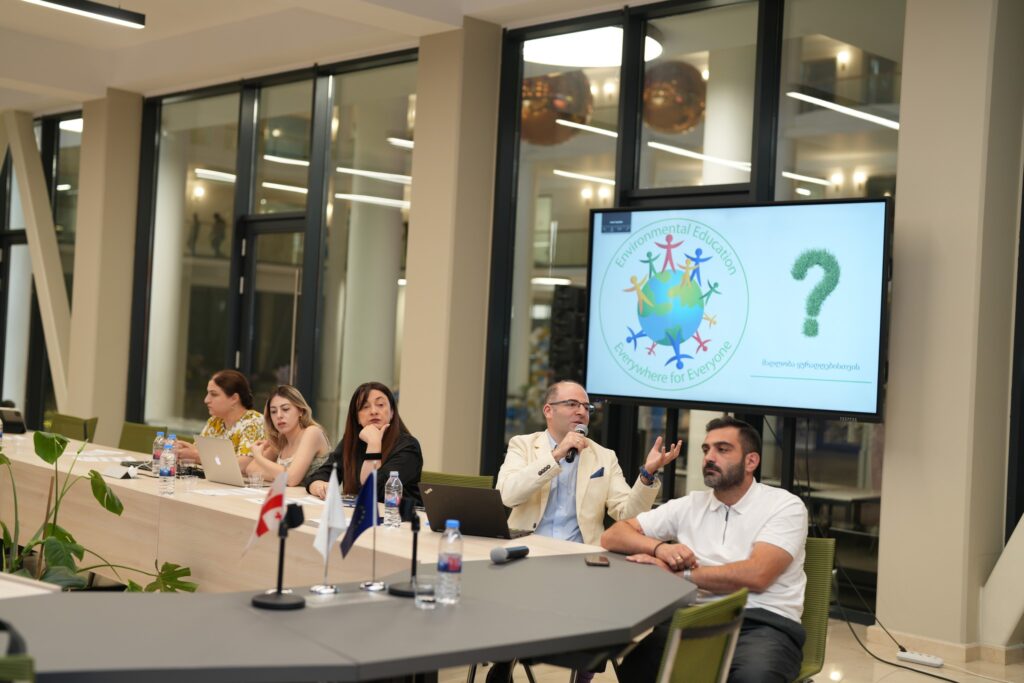
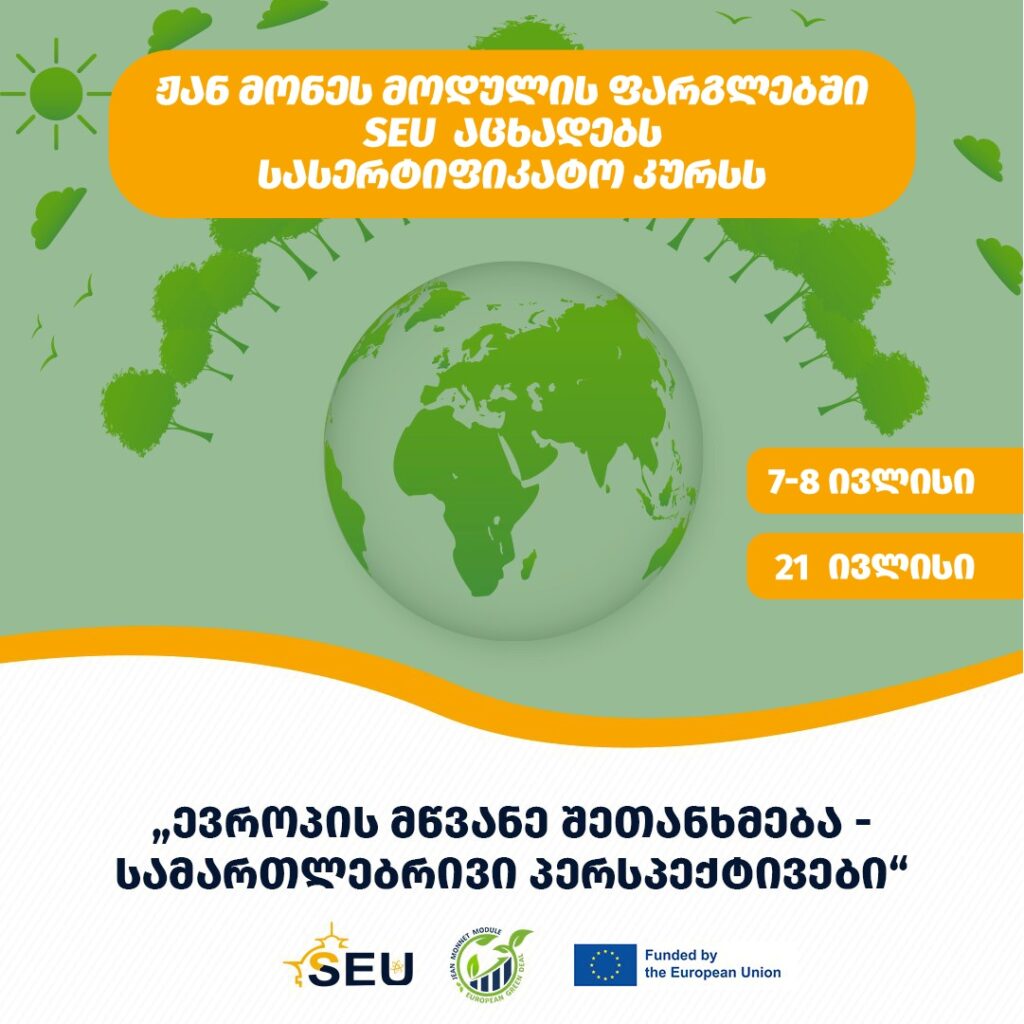
Jean Monnet Project “European Green Deal – Just Transition in Education” is co-funded by the Erasmus+ Programme of the European Union.
Funded by the European Union. Views and opinions expressed are however those of the author(s) only and do not necessarily reflect those of the European Union or the European Education and Culture Executive Agency (EACEA). Neither the European Union nor EACEA can be held responsible for them.
2023 © Georgian National University SEU